This is another ultimate Dx challenge!
A pulsar is a star that has collapsed on itself, with a very small radius, extremely high mass and spinning rapidly! The emitted energy from the pulsar spinning decreases as you go up in frequency, ideally you would choose a lower frequency but there is more man made noise the lower you go… I tried to find a slot around 400MHz but it’s pretty much impossible nowadays so ended up using the 23cm band where there’s not much apart from radar signals.
The strongest pulsar in the Northern Hemisphere is B0329+54, it has a pulse rate of 1.4Hz. I’ve managed to detect this on 405 and 1285MHz, with the best result overall being on 1285MHz but it took many hours of data recording to finally see it.
Pulsar reception is the hardest thing I’ve tried so far!!!
With a relatively small antenna it requires a lot of patience, effort in optimisation and learning how to use the available software.
Detecting the pulsars is usually done by taking the power of a wide chunk of (clean) spectrum, cutting this into time chunks of eg. 714ms for B0329+54 and overlapping them (called folding). The output is a time vs power chart for 0-714ms (pulsar period), the pulsar shows up as a peak in the trace.
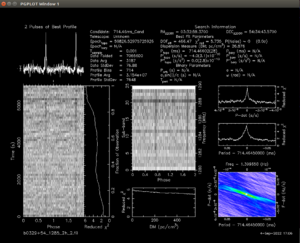
Here’s an example signal from B0329+54 on 1285MHz, it’s the best capture I have got. There are two peaks as the presto software shows two periods.
I’ve tried many times on 400MHz but finding a 10MHz chunk of clear spectrum is very hard, although the signal is obviously stronger, there is just so much interference the overall s/n is not good at all.

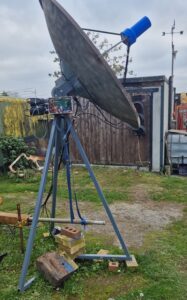
Here’s the Dish with 23cm feed:

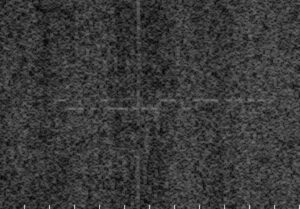
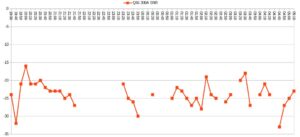
The only other pulsar i might have received is B1642-03, it’s much weaker, here is the received plot:

vrt-iq-tools
I recently came across vrt-iq-tools software that the Dwingloo radio telescope uses. They have a large 25m dish and can hear the Pulsar in real-time, to demo to visitors this they created a gui that displays them…
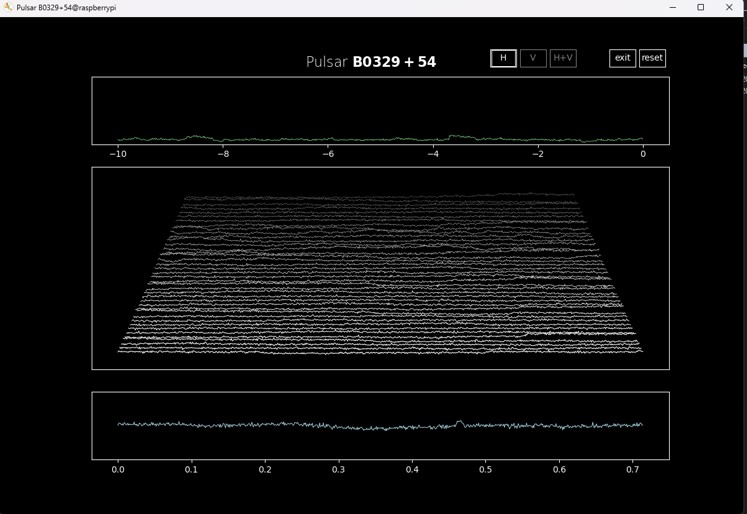
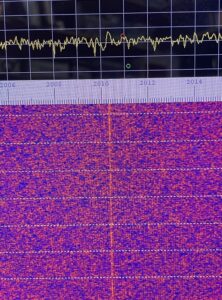
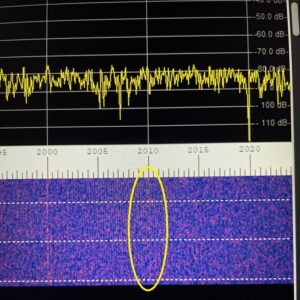
I tried this system on my little 3m dish, obviously no pulses could be heard but it was able to detect Pulsar B0329+24, seen by the small bump on the bottom integration trace! This was on 405MHz where there’s a lot of other interference seen by the top trace.