This has fascinated me for a long time, it’s the ultimate Dx in man made signal reception! until we ever detect an extra terrestrial signal source this is the furthest you can detect an intelligent radio signal from.
Basically it is all about receiving radio signals from spacecraft that are out in space, whatever that actually is 🙂
I’ve had a few attempts at this over the years, starting initially with a 60cm dish and detecting Stereo-A spacecraft which monitors the Sun’s activity. Along the way i tried many time to do this with my 3m mesh dish but it’s just not got a good enough profile for this high frequency.
The actual receive converter is still the same, it’s an unknown make converter from ebay that takes 8.4GHz signals in and outputs them around 900MHz. The LO source is an Elcom Synthesiser set to 9.352GHz which is referenced to a stable 10MHz source. The 10MHz source is a double ovened Morion VCTCXO, this is free running but doesn’t wander far. I’ve tried using other GPSDO’s but they all exhibit ‘wobble’ in the short term which seems to reduce sensitivity when averaging these weak signals.
Over the last couple of years I have finally settled on a repeatable system for monitoring the various spacecraft out there, this is multiple projects that came together. I still have a target of a much larger Solid dish antenna but they are hard to come by!
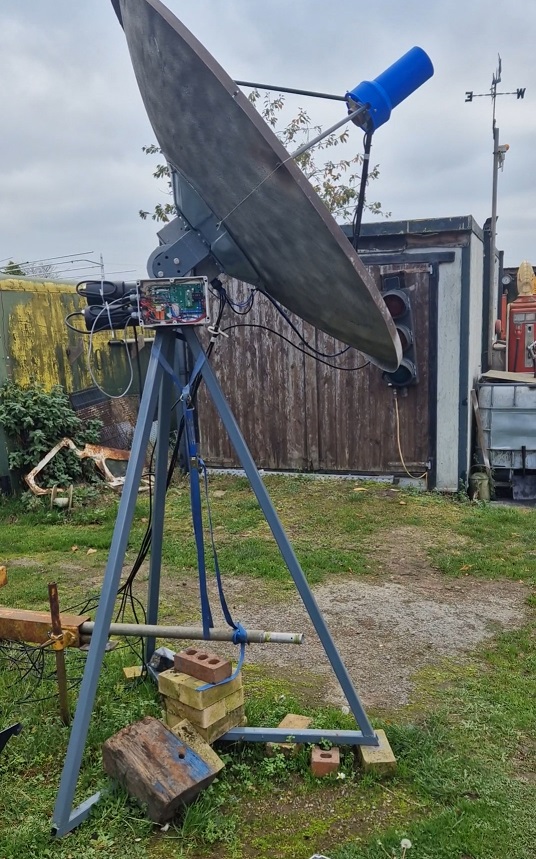
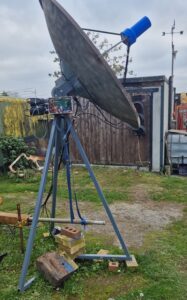
- 1.5m Prime Focus spun aluminium Dish acquired mid 2024
- SVH3 (Az+El) Slew Drive
- Controller for the dish – Raspberry Pico and H-Bridge
- SDR hardware based around a Raspberry Pi and Airspy SDR
- SDR Software designed to bring the wideband SDR data down to baseband and apply doppler tracking
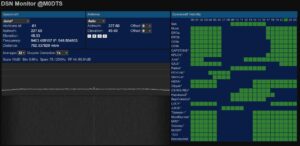
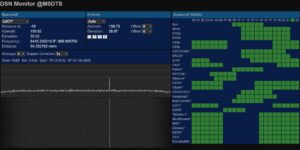
- Web based interface for controlling/displaying the signal, tracking spacecraft and controlling the Antenna.
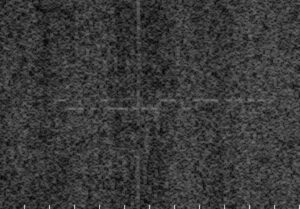
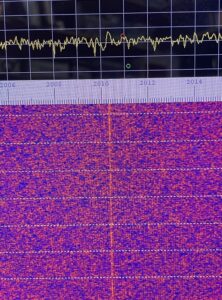
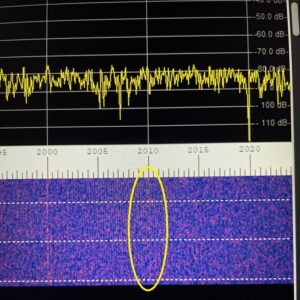
Receiving these signals is often nothing more that detecting the residual carrier for whatever modulation scheme the radio system is using. With dish antenna’s this small there’s just no chance of receiving the data signals, although you can receive data from some spacecraft just after they launch or as they do a fly-by of earth on route to their destination when they are much closer.
The chances of being able to make any sense of the data is slim but if you are into this then take a look at Daniel Estevez’s pages https://destevez.net/
Knowing where the spacecraft can be easy, NASA’s JPL Lab share their data through their Horizons Interface https://ssd.jpl.nasa.gov/horizons/app.html#/ Sometimes no data is available but the are various amateur stations working out the orbits from doppler data once a signal is found, see Scott Tilley’s twitter https://x.com/coastal8049
Many spacecraft don’t send signals continuously so you either have to be very lucky or keep an eye on NASA’s DSN Now page which shows the spacecraft that they are currently communicating with from the main DSN sites. https://eyes.nasa.gov/apps/dsn-now/dsn.html