AVM is a project of mine that lets you send very Narrow Bandwidth live video and sound over the radio, digitally, using a software defined radio (SDR). Designed for HF but may also be useful for multipath on VHF/UHF too.
How it works
Video takes up a lot of room, so the first job is to squash it right down. AVM shrinks the picture and the sound into a small stream of data, much smaller than any of the usual video codecs go down to.
Radio isn’t perfect. Signals fade, there’s noise and interference, and on HF the signal bounces around the sky. So AVM adds extra “spare” information to everything it sends, called error correction. If bits get lost or damaged on the way, the receiver can usually fix them itself and carry on.
Narrow or wide, it’s up to you
AVM can squeeze into a slot as narrow as about 10 kHz. That’s narrow enough for HF, where you could be watching someone a long way away. You won’t get broadcast quality on HF, but seeing a moving picture come in over the band is fascinating!
Give it more room, say on VHF, UHF or higher where you’ve got plenty of bandwidth to play with, and the picture gets bigger, smoother and clearer.
Modes for every kind of conditions
There are several modes to choose from:
- Tough and steady: some modes are built for rough HF paths, where the signal is weak and fading. They’re slower, but they hang on in there.
- Fast and good-looking: other modes are for strong, steady signals, where you can push more data through and get a nicer picture.
- Multi- Path – It’s multi carrier on VU mode where is should do well with signals where there are many reflections going on like around town.
The receiver works out what’s being sent by itself, so the person watching doesn’t have to fiddle with settings to match you, well not too much anyway..
Works with lots of radios
You don’t need special hardware. AVM works with a whole bunch of popular SDRs:
- ADALM Pluto
- LimeSDR
- HackRF
- Airspy and Airspy HF+
- RTL-SDR dongles (for receiving)
- HPSDR-type radios
- KiwiSDR web receivers
The KiwiSDR one is a nice extra. You can receive a station through a KiwiSDR somewhere on the internet, so you can try AVM out without owning a radio at all.It’s also useful for testing if you can receive yourself around teh works on 29MHz for example. My recent test have been quite successful reaching Spain, italy, France, Germany and the canary isles (best at the moment).
Raspberry Pi or Windows
AVM runs on a Raspberry Pi or a Windows PC. The screens are laid out for touch, with big buttons and simple pages, so a Pi with a small touchscreen makes a really neat little self-contained station. There’s also a settings page you can open in a web browser on your phone or another computer.
Handy bits on screen
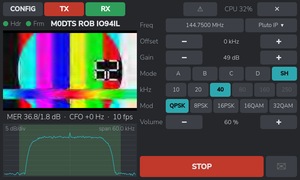
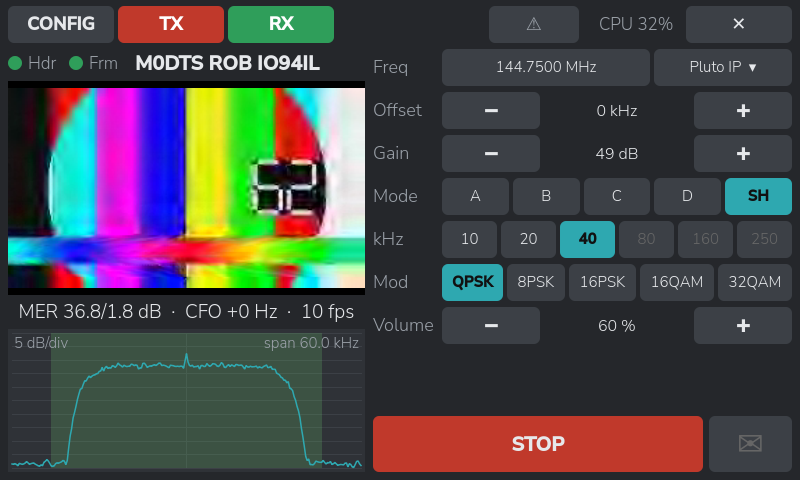
- Spectrum and waterfall: see the signal you’re receiving. Tap it to switch between the two views.
- Lock light: green when you’re getting a good signal, orange when it’s patchy, red when it’s lost.
- Callsign and message: your callsign goes out with the video, along with an optional short text message, so the other end knows who they’re watching.
- Waterfall ID: when you start transmitting, AVM can “paint” your callsign and mode as text on other people’s waterfall displays. Anyone glancing at their waterfall can read who’s on.
- Quick frequencies: your last few frequencies are kept as one-tap buttons.
Where to get it
AVM is on GitHub: github.com/m0dts/avm. There’s a Windows installer, and a simple install script for the Raspberry Pi.
It’s very much a work in progress and I’m always tinkering with it, so expect regular updates and new bits. If you give it a go, let me know how you get on: what radio you used, what band, and how far you got!
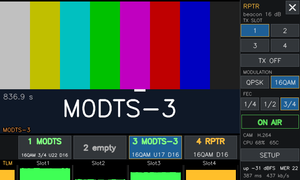
Tx Screen:
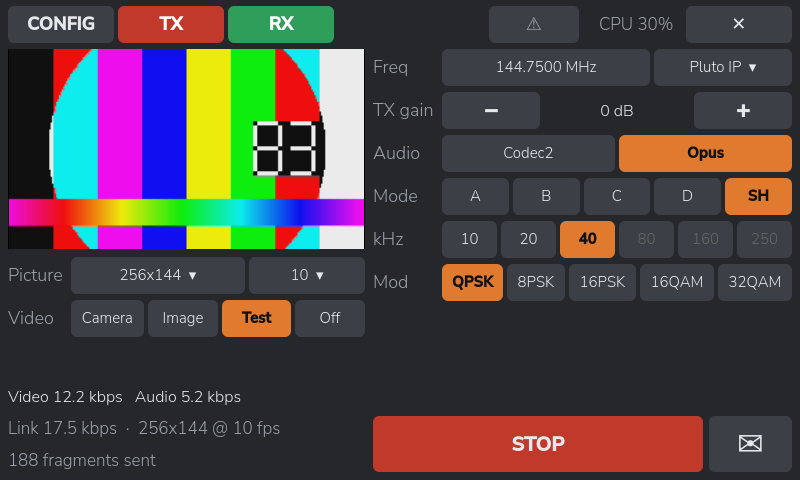
On HF the A-D modes are based on DRM standard for Audio Broadcasting, expect similar performance.
HF ‘SH’ mode is custom single carrier modes which gives surprisingly good results on an average fading HF path with small echoes, the equaliser does it’s work here. This i my favoured mode on HF.
On VHF/UHF there various higher bandwidths also multi carrier, good for multi patch reception, if it received a frame it will show part of a picture, so it will be extremely useful for ‘DX’!
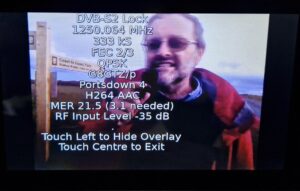
I’ve added in a basic Satellite mode, low bandwidths, very similar to S2 standard but with shorter LDPC for the low data rates involved, it works ok. it will get A/V through bandwidths where regular DVB-S2 probably won’t.